

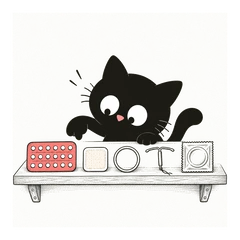
Birth control at a glance
From a daily pill to years from one visit
Think in "how many out of 100 in a year"
It's best to judge birth control by how it works in real life — numbers that include forgetting or being late.
Pregnancies per 100 people in a year, with typical use
IUDs and implants, which last years once placed, are 20 times more effective than the pill, patch, or ring — there's nothing to remember each day.
How each one is used
What to keep track of
Things to watch for
Methods with estrogen, like the pill, patch, and ring, may not suit you if you're over 35 and smoke more than 15 cigarettes a day, have had a stroke, heart attack, or blood clot, or have migraines with aura.
After stopping the injection, it takes about 10 months on average to get pregnant. If you're planning a pregnancy soon, talk with a health professional ahead of time.
Apart from condoms, these methods don't protect against STIs.
How LunaCat can help
Settings › Current situation
If you use hormonal birth control, choose "I'm on hormonal birth control". We'll remind you that ovulation is suppressed, so predictions may not match your body.
This article is for information only. Talk to a health professional about decisions for your body.
IUD or implant — fewer than 1
Injection — 6
Pill, patch, or ring — 9
Tracking dates, temperature, or mucus — 12–24
Pill — one at the same time every day
Patch — a new one each week for 3 weeks, then a week off
Vaginal ring — in for 21 days, out for 7
Injection — once every 13 weeks
Implant — placed under the skin of the upper arm, for up to 5 years
Internal condom — can be put in up to 8 hours before sex
Sources
- Long-Acting Reversible Contraception (LARC): Intrauterine Device (IUD) and Implant — ACOG
- Progestin-Only Hormonal Birth Control: Pill and Injection — ACOG
- Combined Hormonal Birth Control: Pill, Patch, and Ring — ACOG
- Barrier Methods of Birth Control — ACOG
- Fertility Awareness-Based Methods of Family Planning — ACOG